Introduction
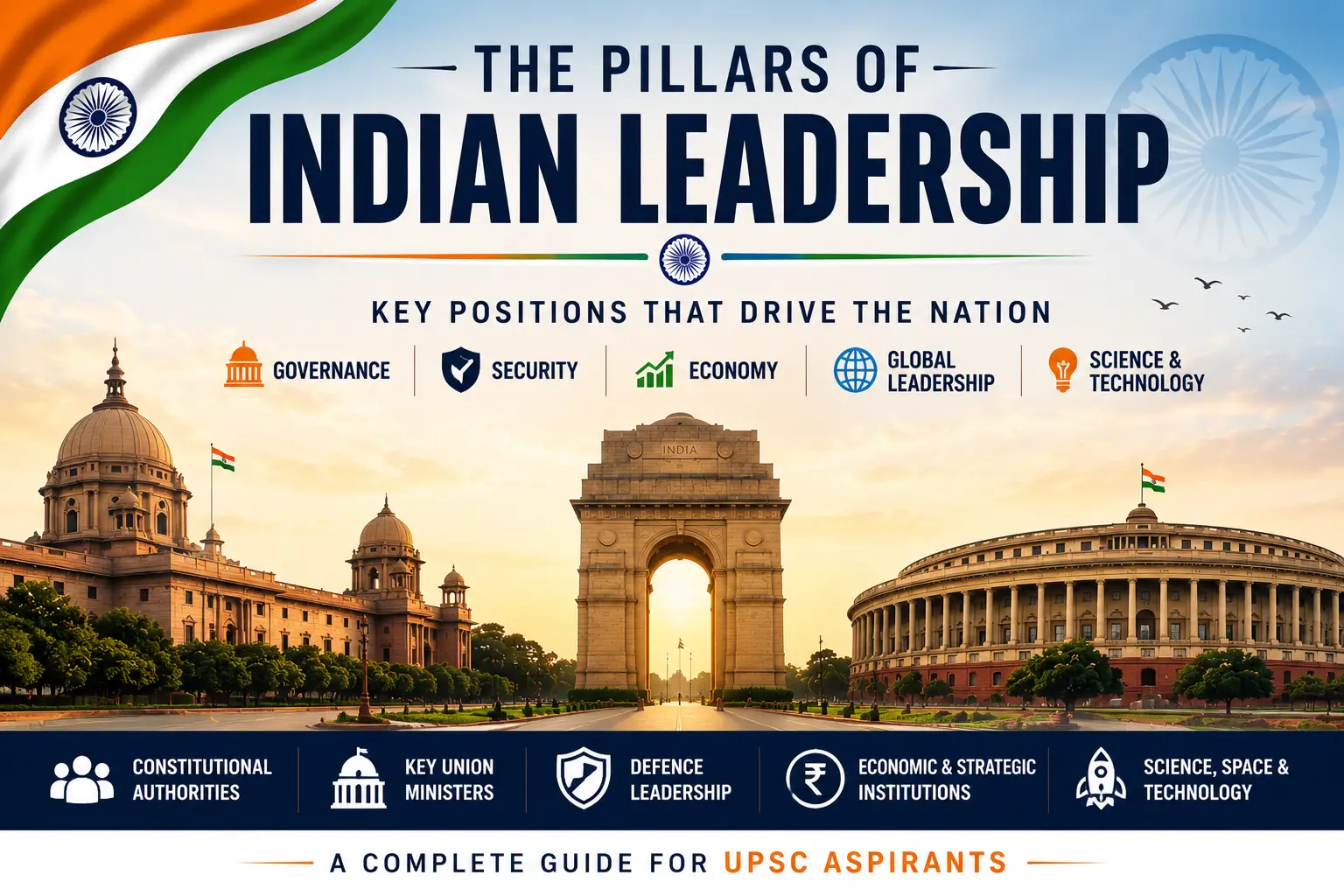
India’s governance structure is powered by a combination of constitutional authorities, executive leadership, strategic institutions, and defence command structures. For UPSC aspirants, understanding these leadership positions is not just important for Polity — it is also essential for Current Affairs, Internal Security, Governance, International Relations, Economy, Science & Technology, and Essay preparation.
From the Prime Minister and President to the Chiefs of the Armed Forces, every position plays a critical role in shaping India’s democracy, economy, national security, and global standing.
In this guide, we explore the most important leadership positions in India from a UPSC perspective.
Why These Positions Matter for UPSC
Understanding India’s leadership ecosystem helps aspirants:
-Understand constitutional governance
-Improve polity and governance concepts
-Build analytical understanding for Mains answers
-Strengthen interview preparation
-Connect current affairs with institutional functioning
-Improve essay writing and GS answer quality
These positions are frequently asked in:
-UPSC Prelims
-UPSC Mains GS Papers
-UPSC Interview
-State PSC examinations
-Current affairs discussions
1. Prime Minister of India
Current Office Holder
Narendra Modi
Constitutional Position
The Prime Minister is the head of government and the real executive authority in India.
Key Responsibilities
-Leads the Union Government
-Chairs the Union Cabinet
-Advises the President
-Shapes domestic and foreign policy
-Coordinates ministries and departments
UPSC Relevance
Important topics:
-Parliamentary system
-Executive powers
-Cabinet system
-Centre-state relations
-Governance reforms
2. President of India
Current Office Holder
Droupadi Murmu
Constitutional Position
The President is the constitutional head of the Indian State and Supreme Commander of the Armed Forces.
Key Responsibilities
-Appoints Prime Minister and Governors
-Gives assent to bills
-Declares emergencies
-Exercises constitutional powers
-Represents the unity of the nation
UPSC Relevance
Important topics:
-Emergency provisions
-Ordinance powers
-Constitutional framework
-Electoral college
-Executive-legislative relations
3. Vice President of India
Current Office Holder
Jagdeep Dhankhar
Constitutional Position
The Vice President is the second-highest constitutional office in India.
Key Responsibilities
-Chairman of Rajya Sabha
-Presides over Upper House proceedings
-Acts as President during vacancy
UPSC Relevance
Important topics:
-Parliamentary procedures
-Rajya Sabha functions
-Constitutional offices
-Federal structure
4. Chief Justice of India (CJI)
Current Office Holder
Justice B. R. Gavai
Constitutional Position
The Chief Justice of India is the head of the Indian judiciary and Supreme Court.
Key Responsibilities
-Leads the Supreme Court
-Protects constitutional values
-Oversees judicial administration
-Allocates cases to bences
-Interprets the Constitution
UPSC Relevance
Important topics:
-Judicial review
-Judicial independence
-Basic structure doctrine
-Separation of powers
-Constitutional interpretation
5. Home Minister of India
Current Office Holder
Amit Shah
Role in Government
The Home Minister oversees internal security and domestic governance.
Key Responsibilities
-Internal security
-Law and order
-Border management
-Disaster management
-Coordination with states
UPSC Relevance
Important topics:
-Internal security
-Federalism
-NIA and security agencies
-Disaster management
-Border security
6. Defence Minister of India
Current Office Holder
Rajnath Singh
Role in Government
The Defence Minister oversees India’s defence administration and military preparedness.
Key Responsibilities
-Defence policy
-Military modernisation
-Defence procurement
-National security strategy
-Coordination with armed forces
UPSC Relevance
Important topics:
-National security
-Defence modernisation
-Atmanirbhar Bharat in defence
-Defence technology
-Strategic affairs
7. Finance Minister of India
Current Office Holder
Nirmala Sitharaman
Role in Government
The Finance Minister manages India’s economic and fiscal policies.
Key Responsibilities
-Union Budget
-Taxation policies
-Fiscal planning
-Banking reforms
-Economic governance
UPSC Relevance
Important topics:
-Budget and taxation
-Fiscal deficit
-Banking system
-Economic reforms
-Inflation and growth
8. Minister of External Affairs
Current Office Holder
Dr. S. Jaishankar
Role in Government
The External Affairs Minister shapes India’s foreign policy and diplomatic engagement.
Key Responsibilities
-Diplomatic relations
-International negotiations
-Strategic partnerships
-Global representation
-Foreign policy execution
UPSC Relevance
Important topics:
-International relations
-Indo-Pacific strategy
-Global organisations
-India’s foreign policy
-Geopolitics
9. RBI Governor
Current Office Holder
Sanjay Malhotra
Institutional Role
The RBI Governor heads the Reserve Bank of India.
Key Responsibilities
-Monetary policy
-Inflation management
-Banking regulation
-Currency management
-Financial stability
UPSC Relevance
Important topics:
-Monetary policy
-Repo rate
-Inflation
-Banking system
-Financial regulation
10. ISRO Chairman
Current Office Holder
V. Narayanan
Institutional Role
The ISRO Chairman leads India’s space programme.
Key Responsibilities
-Space missions
-Satellite programmes
-Launch vehicle development
-Space applications
-Scientific innovation
UPSC Relevance
Important topics:
-Science and technology
-Space missions
-Satellite systems
-Space economy
-Technological innovation
11. DRDO Chairman
Current Office Holder
Dr. Samir V. Kamat
Institutional Role
The DRDO Chairman heads India’s defence research ecosystem.
Key Responsibilities
-Defence research
-Indigenous defence systems
-Strategic technology development
-Military innovation
-Defence modernisation
UPSC Relevance
Important topics:
-Defence technology
-Missile systems
-Defence indigenisation
-Strategic capability
-National security
12. Chief of Defence Staff (CDS)
Current Office Holder
General Anil Chauhan
Institutional Role
The CDS is the principal military adviser to the Government of India.
Key Responsibilities
-Jointness among armed forces
-Military integration
-Strategic coordination
-Theatre command planning
-Defence reforms
UPSC Relevance
Important topics:
-Defence reforms
-Theatre commands
-Joint military operations
-National security architecture
-Civil-military relations
13. Chief of Army Staff (COAS)
Current Office Holder
General Upendra Dwivedi
Institutional Role
The COAS heads the Indian Army.
Key Responsibilities
-Operational preparedness
-Border security
-Counter-insurgency operations
-Army modernisation
-Personnel management
UPSC Relevance
Important topics:
-Border security
-Internal security
-Military leadership
-Defence preparedness
-Strategic studies
14. Chief of Air Staff (CAS)
Current Office Holder
Air Chief Marshal Amar Preet Singh
Institutional Role
The CAS heads the Indian Air Force.
Key Responsibilities
-Air defence
-Aerospace power
-Air operations
-Technological modernisation
-Strategic air capability
UPSC Relevance
Important topics:
-Air power
-Defence technology
-Aerospace systems
-Space and cyber operations
-National security
15. Chief of Naval Staff (CNS)
Current Office Holder
Admiral Dinesh K Tripathi
Institutional Role
The CNS heads the Indian Navy.
Key Responsibilities
-Maritime security
-Naval modernisation
-Indo-Pacific strategy
-Sea lane protection
-Undersea warfare preparedness
UPSC Relevance
Important topics:
-Maritime security
-Blue economy
-Indo-Pacific region
-Naval strategy
-Geopolitics
Key Takeaways for UPSC Aspirants
India’s leadership structure reflects the balance between:
-Constitutional governance
-Democratic accountability
-Economic management
-National security
-Scientific advancement
-Strategic diplomacy
Aspirants should not study these positions in isolation. Instead, they should connect them with:
-Current affairs
-Government schemes
-Institutional reforms
-International developments
-Security challenges
-Economic policy changes
This approach improves analytical understanding and answer-writing quality.
Conclusion
The pillars of Indian leadership are not limited to elected representatives alone. India’s governance ecosystem includes constitutional authorities, ministers, strategic institutions, scientific leadership, and military command structures.
For UPSC aspirants, understanding these positions helps build a deeper understanding of how India functions as a democracy and as a global power.
Whether it is governance, economy, defence, diplomacy, or science and technology — these leadership positions collectively shape the future of India.
Leave a Reply